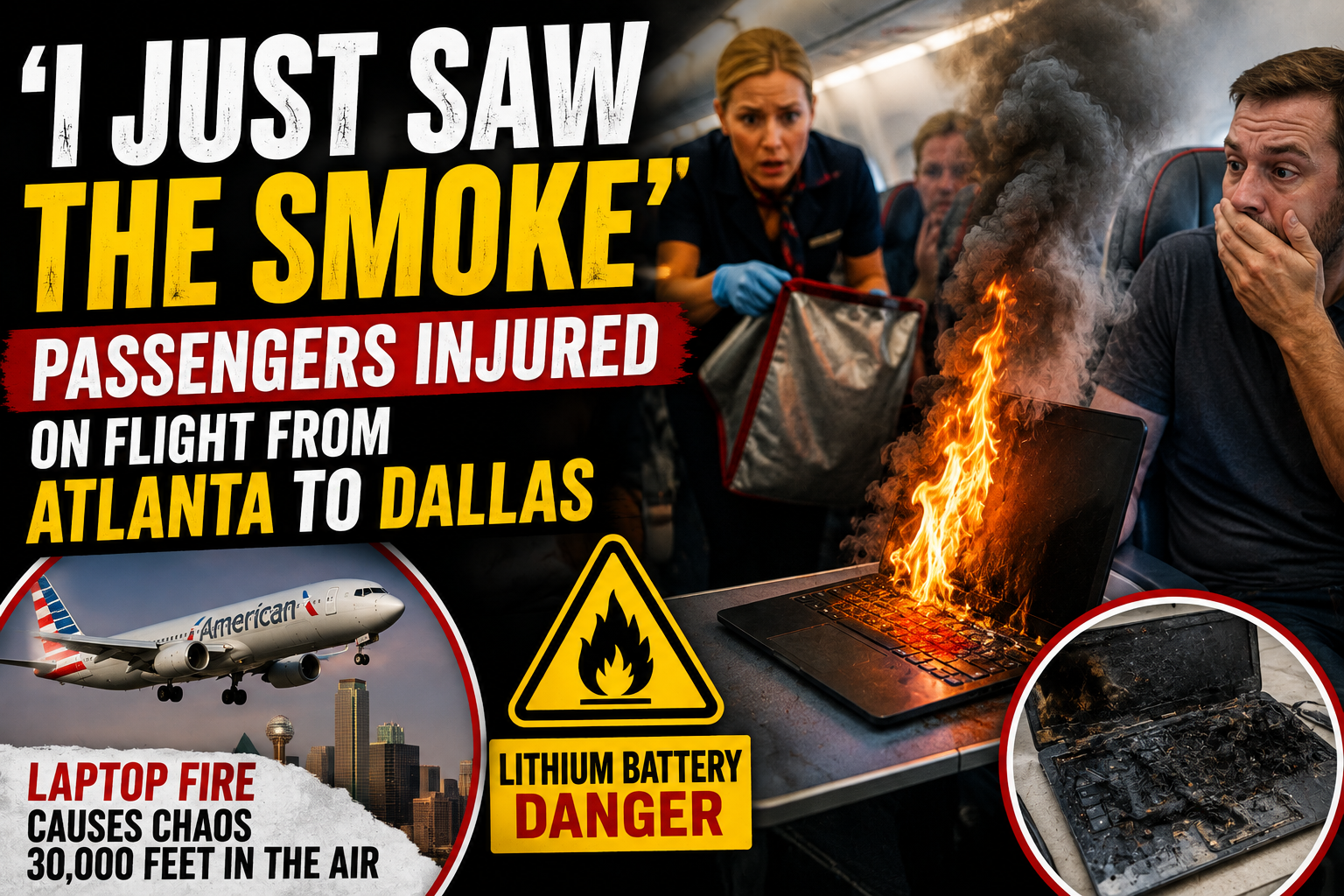
What began as a routine American Airlines flight from Atlanta to Dallas quickly turned terrifying when a passenger’s laptop began smoking and caught fire inside the cabin.
Passengers aboard American Airlines Flight 2398 described smoke spreading through the aircraft as travelers and flight attendants rushed to contain the burning device during the final portion of the flight on Friday, August 21.
The flight, which was carrying 133 people, ultimately landed safely at Dallas Fort Worth International Airport at approximately 6:55 p.m. local time. But air traffic control recordings indicate the pilot believed as many as four or five passengers may have suffered burns during the incident. (CBS News)
One passenger was officially treated at the scene and released after landing, according to authorities. (CBS News)
For those inside the aircraft, however, the minutes before landing were frightening.
‘I Just Saw the Smoke’
Passenger Jessica Irgens was sitting only a few rows away when the emergency began.
“I just saw the smoke first, and then it all happened really fast,” Irgens recalled. (WSB-TV Channel 2 – Atlanta)
She told reporters that flames and smoke appeared several rows ahead of her while the laptop’s owner attempted to move the device away from himself and into the aisle.
What followed was a scramble inside the cabin.
Passengers attempted to help while flight attendants responded to the burning computer. Irgens said she later saw two people with their hands placed in bags of ice, visibly shaken following the incident. (WSB-TV Channel 2 – Atlanta)
The fire reportedly occurred roughly 30 minutes before the end of the flight.
As smoke filled the cabin, Irgens moved toward the rear of the plane. The laptop was eventually placed in the aisle as people attempted to get the burning device under control. (CBS News)
Pilot Reported a ‘Cabin Fire’
The seriousness of the situation can be heard in communications between the pilots and air traffic controllers.
According to CBS News, the flight crew reported a cabin fire while flight attendants were attempting to extinguish it.
Later, the pilot told controllers the laptop had been contained and indicated that approximately four or five passengers may have been burned by the device. (CBS News)
The plane continued toward Dallas Fort Worth rather than diverting elsewhere because it was already approaching its destination.
Emergency personnel were ready when the aircraft arrived.
Despite the frightening situation inside the cabin, Flight 2398 landed safely at DFW.
Flight Attendants Used a Thermal Containment Bag
One of the most important parts of the incident was the crew’s response.
The Federal Aviation Administration said flight attendants were able to place the burning laptop inside a thermal containment bag. (WSB-TV Channel 2 – Atlanta)
These specialized bags are designed to help isolate overheating or burning electronic devices and limit the spread of flames, heat and debris inside an aircraft.
According to the passenger account reported by CBS News, the crew had the laptop sealed inside the containment bag within roughly five minutes. (CBS News)
American Airlines praised the crew afterward.
The airline confirmed Flight 2398 landed safely following reports of smoke from a customer’s device during landing and thanked crew members for their quick response. (CBS News)
The FAA is investigating the incident. (CBS News)
How Many Passengers Were Injured?
There is an important distinction between the initial reports from the cockpit and the confirmed medical information following the landing.
Air traffic control audio indicated the pilot believed four to five people may have been burned.
Passenger accounts also described people suffering apparent injuries to their hands while attempting to help with the burning laptop. (WSB-TV Channel 2 – Atlanta)
However, officials confirmed that one passenger received treatment and was released at the scene following the landing. (CBS News)
That means reports of four or five injuries should still be treated as preliminary rather than a confirmed final injury count.
What Caused the Laptop Fire?
The specific cause of the laptop fire has not yet been publicly determined.
However, laptops commonly use lithium-ion batteries, which can become dangerous if they overheat or enter a condition known as thermal runaway.
The FAA explains that thermal runaway can happen when a lithium-ion battery becomes damaged, overheated, overcharged or improperly protected. Manufacturing defects can also potentially trigger the process. (Federal Aviation Administration)
Once thermal runaway begins, the temperature inside a battery cell can rise rapidly.
That can result in:
- Smoke
- Extreme heat
- Fire
- Venting gases
- Additional nearby battery cells overheating
And in the confined environment of an airplane cabin, even a relatively small electronic-device fire can become a serious emergency.
Why Lithium Battery Fires on Airplanes Are Different
A typical fire is already dangerous.
A lithium battery fire presents additional challenges because damaged battery cells can continue generating heat even after the visible flames appear to be under control.
That’s one reason aviation authorities pay so much attention to laptops, smartphones, power banks and other rechargeable electronics.
The FAA says all lithium-ion batteries are capable of overheating and experiencing thermal runaway under the wrong conditions. (Federal Aviation Administration)
Flight crews receive training to recognize and respond to these incidents.
And the Atlanta-to-Dallas incident demonstrates exactly why.
In this case, the problem was identified inside the passenger cabin, allowing flight attendants to reach the laptop and contain it quickly.
Had a similar event occurred somewhere inaccessible during flight, responding could have been much more difficult.
Lithium Battery Incidents Aren’t Extremely Rare
The American Airlines incident is not the first time a rechargeable electronic device has caused smoke or fire aboard an aircraft.
CBS News reported that the FAA had recorded at least 56 aviation incidents involving lithium batteries and smoke, fire or overheating in 2026 by the time of the Flight 2398 incident. (CBS News)
Earlier this year, an Alaska Airlines flight headed toward Wichita returned to Seattle after a passenger’s portable power bank overheated and caught fire. (CBS News)
The increasing number of battery-powered devices people travel with means passengers may now board aircraft carrying several lithium batteries without thinking much about it.
A typical traveler could have:
- A smartphone
- Laptop
- Tablet
- Wireless headphones
- Smartwatch
- Portable charger
- Camera
- Spare batteries
Most are used every day without incident.
But when lithium batteries fail, the consequences can be serious.
Should Laptops Be in Carry-On or Checked Baggage?
The FAA recommends that devices containing lithium batteries — including laptops, smartphones and tablets — be carried in accessible carry-on baggage. (Federal Aviation Administration)
That might sound counterintuitive after hearing about a laptop catching fire inside an aircraft cabin.
But accessibility is precisely the reason.
If a laptop begins overheating in the cabin, passengers can notice the smoke or unusual heat and alert flight attendants.
The crew can then respond immediately.
A fire developing inside checked luggage in the cargo hold can be considerably harder to access.
If a battery-powered electronic device must be placed in checked baggage, FAA guidance says it should be completely powered off and protected against accidental activation and physical damage. (Federal Aviation Administration)
Power Banks and Spare Lithium Batteries Have Even Stricter Rules
Travelers should also understand that spare batteries and power banks are treated differently from laptops containing installed batteries.
The FAA says spare lithium batteries and portable chargers must be carried in carry-on baggage and cannot be placed in checked luggage. (Federal Aviation Administration)
If your carry-on bag is unexpectedly checked at the gate, the FAA advises removing spare lithium batteries and power banks before handing over the bag. (Federal Aviation Administration)
Battery terminals should also be protected from short circuits.
Depending on the battery’s capacity, additional restrictions may apply.
Lithium-ion batteries rated between 101 and 160 watt-hours generally require airline approval, while batteries exceeding 160 Wh are forbidden on passenger aircraft under standard passenger rules. (Federal Aviation Administration)
Warning Signs Your Laptop Battery Could Be Failing
One important lesson from Flight 2398 is how quickly a battery emergency can develop.
Passengers should immediately alert a flight attendant if a device begins behaving unusually.
Potential warning signs include:
Excessive heat: A laptop or battery becomes unusually hot even when it isn’t performing demanding tasks.
Swelling: The laptop case, trackpad or keyboard begins bulging because the battery underneath is expanding.
Unusual smell: A chemical, sweet or burning smell appears around the device.
Hissing or popping sounds: Strange noises can indicate a battery is failing internally.
Smoke: At this point the situation should be treated as an immediate emergency.
The FAA specifically advises passengers to notify flight crews immediately if a battery-powered device is overheating, expanding, smoking or burning. (Federal Aviation Administration)
Passengers should not attempt to quietly manage a serious battery problem themselves.
What Should You Do If a Laptop Starts Smoking on a Plane?
The most important action is simple:
Tell the flight crew immediately.
Flight attendants are trained to respond to lithium battery emergencies and have access to equipment and procedures passengers may not.
Passengers should follow crew instructions and move away from the affected area when directed.
The Flight 2398 incident also highlights the danger of trying to grab or move a burning device with bare hands.
Some of the reported injuries occurred when passengers attempted to help with the laptop.
Wanting to help is understandable.
But a battery in thermal runaway can become extremely hot.
What looks like a small laptop fire can cause serious burns within seconds.
What About Damaged or Recalled Batteries?
The FAA warns passengers not to travel with damaged or recalled lithium batteries or battery-powered devices that are likely to generate dangerous heat or sparks unless the problematic battery has been removed or otherwise made safe. (Federal Aviation Administration)
That makes checking battery recalls important before flying, particularly if your device has recently been the subject of a manufacturer’s safety warning.
Visible damage should also be taken seriously.
A laptop that was recently crushed, dropped severely, punctured or exposed to water may deserve additional attention before it is brought aboard an aircraft.
Flight 2398 Landed Safely — But Passengers Won’t Forget It
For the 133 people aboard American Airlines Flight 2398, the incident ended without a larger disaster.
The plane landed safely.
The laptop was contained.
Emergency responders were waiting.
At least one passenger was treated and released.
But accounts from the cabin show how frightening the incident became within moments.
Passengers described smoke, flames, injured travelers and the sudden realization that a device almost everyone carries could become a fire hazard thousands of feet in the air.
For Jessica Irgens, the memory was simple and immediate: she saw smoke — and then everything happened fast.
Why This Incident Matters for Travelers
Millions of passengers fly every day carrying devices powered by lithium-ion batteries.
The overwhelming majority never experience a problem.
That shouldn’t create panic.
But Flight 2398 is an important reminder that travelers should know what to do if a device starts overheating.
Keep laptops and rechargeable electronics accessible.
Pay attention if a battery appears swollen or damaged.
Don’t put spare lithium batteries or power banks in checked luggage.
And if a device begins smoking or overheating during a flight, alert the crew immediately.
Those few seconds could matter.
The Bottom Line
An American Airlines flight from Atlanta to Dallas Fort Worth turned frightening Friday when a passenger’s laptop caught fire inside the cabin shortly before landing.
Flight attendants responded quickly and contained the laptop using a thermal containment bag.
The pilot told air traffic controllers that as many as four or five passengers may have suffered burns, although officials have confirmed that one passenger was treated at the scene and released. The aircraft, carrying 133 people, landed safely at DFW at approximately 6:55 p.m. local time. (CBS News)
The FAA is now investigating.
While the exact cause of the laptop fire remains unclear, the incident highlights a growing aviation safety issue involving the lithium-ion batteries that power laptops, phones, tablets and portable chargers.
For passengers, the message is straightforward:
If your device starts getting dangerously hot, expanding, smoking or burning during a flight, don’t wait. Tell a flight attendant immediately.

Leave a Reply