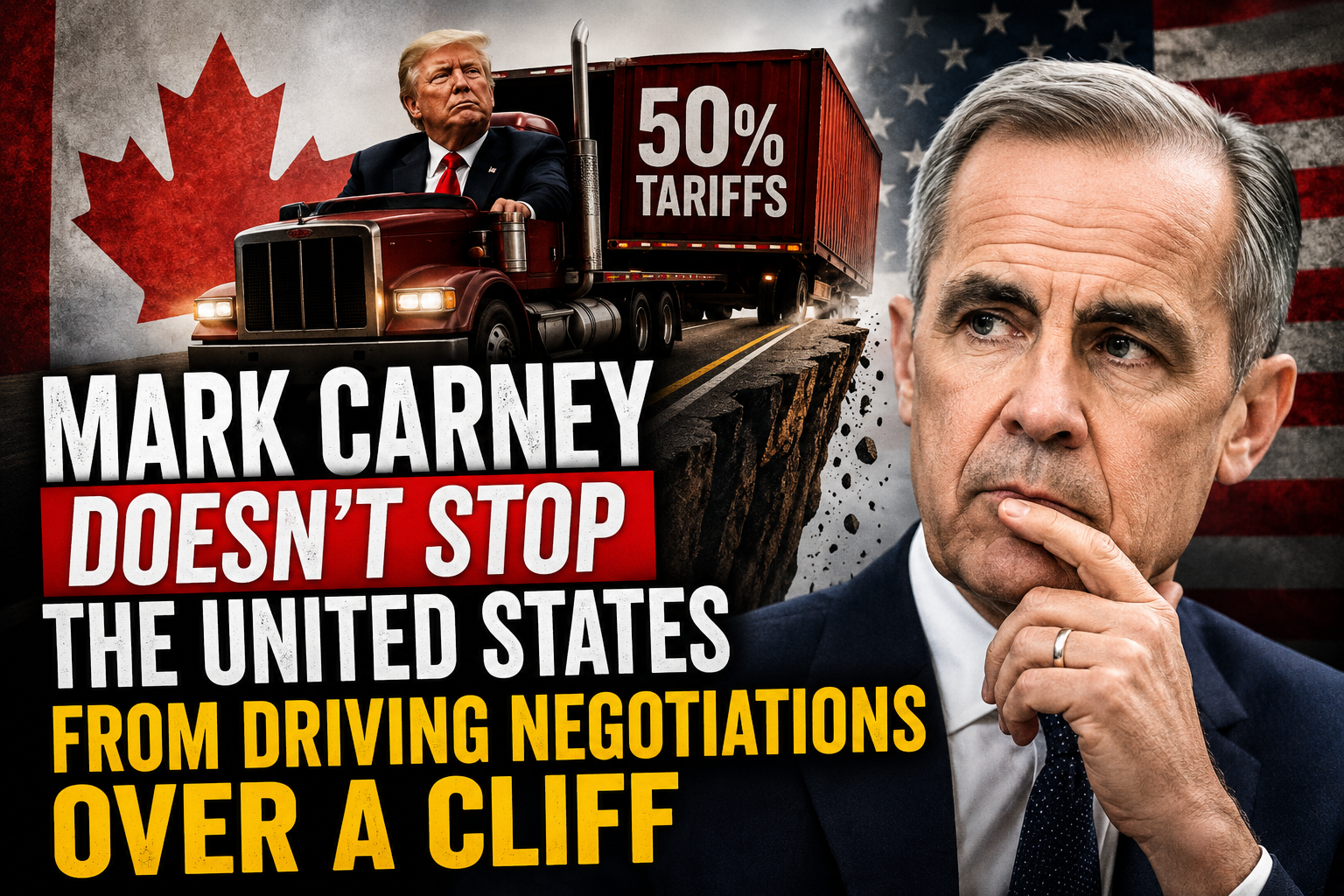
For several days, Canada and the United States appeared to be approaching the finish line on a new trade agreement.
Then the negotiations went over a cliff.
Prime Minister Mark Carney emerged Saturday defending Canada’s decision not to accept the agreement being offered by Washington, arguing that the final terms had become unacceptable. The collapse triggered another major escalation in the Canada-U.S. trade war, with new 50% American tariffs on roughly $20 billion worth of Canadian goods taking effect and Ottawa preparing fresh retaliation.
It is an extraordinary reversal.
Only days earlier, U.S. President Donald Trump was publicly suggesting a deal was effectively done. On August 19, Trump said the two countries had reached what he called a “very fair” agreement that still needed to be finalized. One day later, Canadian Trade Minister Dominic LeBlanc said negotiators were “very close” to reaching a deal.
Instead of an agreement, Canada received another round of tariffs.
And the question now is much bigger than who won or lost one week of negotiations.
Can Canada still build a predictable economic relationship with the United States at all?
Canada and the U.S. Were Inches From a Deal
The frustrating part for Canadian businesses is that this wasn’t a negotiation that appeared hopeless from the beginning.
There had been genuine movement.
According to Reuters, negotiators had been discussing an agreement that could have lowered the U.S. tariff on Canadian-built vehicles from 25% to 15% and reduced tariffs on Canadian steel and aluminum.
Those would have been meaningful concessions for some of Canada’s most important industries.
Automobiles were among the most complicated issues.
Washington reportedly wanted tariff calculations to recognize primarily U.S.-made content inside Canadian vehicles. Canada pushed for a broader North American approach that would recognize Canadian, American and Mexican components within deeply integrated continental supply chains.
The negotiations also touched dairy access, Canadian restrictions on American alcohol, steel, aluminum and other long-running trade disputes.
These were difficult issues.
But difficult negotiations are normal between major trading partners.
What wasn’t normal was how quickly the apparent breakthrough disappeared.
Then Everything Fell Apart
The United States ultimately imposed 50% tariffs affecting approximately $20 billion in Canadian exports after the two governments failed to reach an agreement.
Products affected include goods across sectors such as dairy, wine, wood products and other manufactured exports. The affected trade represents only a portion of Canada’s overall exports to the United States, but the impact could be severe for individual companies and communities that depend heavily on cross-border sales.
The two governments tell the ending somewhat differently.
The U.S. position is that Canada declined to finalize an agreement that Washington believed offered favourable terms.
Carney’s position is that the cumulative American demands — including last-minute changes — turned the proposed agreement into something Canada could no longer responsibly sign.
That distinction matters.
Walking away from an imperfect deal is one thing.
Walking away because the deal itself keeps changing is something else entirely.
Carney’s Biggest Problem Isn’t Just Tariffs
Mark Carney now faces a challenge that extends far beyond tariff percentages.
It’s predictability.
Companies can survive costs they understand.
They can adjust supply chains. They can change prices. They can move production. They can sign contracts based on known rules.
What businesses struggle to manage is a trading relationship where the rules themselves can change rapidly.
Canada and the United States spent decades building one of the world’s most integrated economic relationships.
Parts routinely cross the border several times before becoming finished products. Canadian factories depend on American customers. American factories depend on Canadian materials, energy and components.
That system requires stability.
And stability becomes difficult when businesses don’t know what tariff could appear next month.
Was Carney Right to Walk Away?
That is the political question Canadians will debate.
Carney’s argument is straightforward: no deal is better than a bad deal.
There is logic behind it.
Accepting an agreement merely because the alternative is painful could encourage Washington to demand additional concessions every time another deadline approaches.
There is also a sovereignty question.
A trade agreement is supposed to establish rules both sides can rely on. If one country believes those rules can continually be reopened through tariff threats, the value of the agreement itself begins to deteriorate.
But walking away carries serious costs too.
Canadian exporters are now facing additional barriers to their largest foreign market. Companies operating on thin margins may have difficulty absorbing a 50% tariff. Investment decisions could be postponed, production could decline and jobs could ultimately be threatened.
Canada sends nearly 70% of its exports to the United States, meaning economic diversification cannot replace the American market overnight.
Carney may have avoided a deal he believed was unacceptable.
He has not avoided the economic consequences of having no deal.
Canada’s Retaliation Is Coming
Ottawa isn’t simply absorbing the new tariffs.
Carney announced that Canada will impose additional retaliatory tariffs on American products beginning September 8, 2026, describing Canada’s approach as effectively dollar-for-dollar retaliation.
The federal government is also preparing support for Canadian industries affected by the escalating dispute.
That introduces another dangerous possibility.
The United States imposes tariffs.
Canada retaliates.
Washington responds to Canada’s retaliation.
Canada responds again.
Trade disputes can become self-reinforcing remarkably quickly.
And each additional tariff makes returning to the negotiating table politically more difficult.
CUSMA Is Suddenly More Important Than Ever
There is at least one important stabilizer remaining: the Canada-United States-Mexico Agreement, or CUSMA.
Earlier this year, the Canadian government estimated that approximately 85% of Canadian exports to the United States continued entering tariff-free under CUSMA, giving Canada a substantially lower effective U.S. tariff rate than many other major American trading partners.
That protection matters enormously.
But the latest dispute raises uncomfortable questions about the future of the North American trade framework.
If Washington increasingly relies on tariffs outside the traditional CUSMA structure, businesses may begin questioning how much certainty the agreement actually provides.
That uncertainty could become almost as economically damaging as tariffs themselves.
Canada Has Been Preparing for This Moment
Carney’s government has increasingly emphasized reducing Canada’s dependence on the United States.
Canada has pursued deeper trade relationships with Europe and Asia while working toward agreements or negotiations involving ASEAN countries, the Philippines, Mercosur and other markets.
The federal government’s stated strategy is to expand relationships in areas including critical minerals, defence, energy, artificial intelligence and agriculture while maintaining access to the American economy.
That diversification now looks less like an optional economic strategy and more like an insurance policy.
Canada will never completely replace the United States as a trading partner.
The geography alone makes that unrealistic.
But Canada can reduce the amount of leverage Washington gains from Canada’s dependence on a single market.
That will take years, not months.
Trump Has Changed the Rules of the Relationship
The larger story isn’t really about one tariff deadline.
It’s about a fundamental change in how Washington views trade.
The Trump administration has repeatedly demonstrated a willingness to use market access as negotiating leverage. Tariffs aren’t simply being treated as tools to protect particular industries. They have become instruments of broader economic diplomacy.
For Canada, that means the old assumption that economic integration guarantees stability may no longer be sufficient.
Carney’s government appears to understand that.
The problem is that recognizing a new reality doesn’t make dealing with it easier.
Canada remains deeply integrated with an American economy roughly ten times its size.
Washington has leverage.
Pretending otherwise would be foolish.
The challenge for Carney is determining how much compromise represents pragmatic negotiation — and at what point compromise becomes unacceptable dependence.
What Happens Next?
For the moment, the situation appears frozen.
No immediate new negotiating round has been announced following the breakdown, while Canadian counter-tariffs are scheduled to begin September 8.
But neither country can simply walk away from the relationship.
Their economies are too interconnected.
Eventually, someone will have to return to the negotiating table.
The real question is what happens before then.
Will Washington reconsider some of its demands?
Will Canada offer additional concessions?
Will another round of tariffs make compromise harder?
Or will economic pressure from businesses and workers on both sides of the border force governments back toward an agreement?
Those questions now matter far more than the drama surrounding one deadline.
The Bottom Line
Mark Carney didn’t stop the United States from driving Canada-U.S. trade negotiations over the cliff.
He ultimately decided not to climb into the passenger seat.
Whether that proves to be a smart act of economic self-preservation or an enormously costly missed opportunity will depend on what happens next.
For Carney, saying no to a bad deal may prove easier than managing the consequences.
For Trump, applying another round of tariffs may increase American leverage — but it also risks accelerating the exact development Washington should worry about: a Canada increasingly determined to reduce its economic dependence on the United States.
The Canada-U.S. relationship isn’t ending.
It is changing.
And after the events of this week, Canadian governments, businesses and workers may have to start planning for a world in which uncertainty south of the border isn’t a temporary crisis.
It is the new normal.
Suggested URL Slug
mark-carney-us-trade-talks-canada-tariffs
Suggested Google SEO Keywords
Mark Carney, Mark Carney Trump, Canada U.S. trade deal, Canada U.S. tariffs, Trump tariffs Canada, Canada trade war 2026, 50% tariffs Canada, Canada U.S. trade negotiations, CUSMA, Canadian tariffs, U.S. tariffs on Canada
Suggested Tags
Mark Carney, Donald Trump, Canada, United States, Tariffs, Trade War, Canadian Economy, U.S. Economy, CUSMA, Politics, Business, Breaking News

Leave a Reply