Canada’s trade relationship with the United States has entered one of its most tense periods in decades.
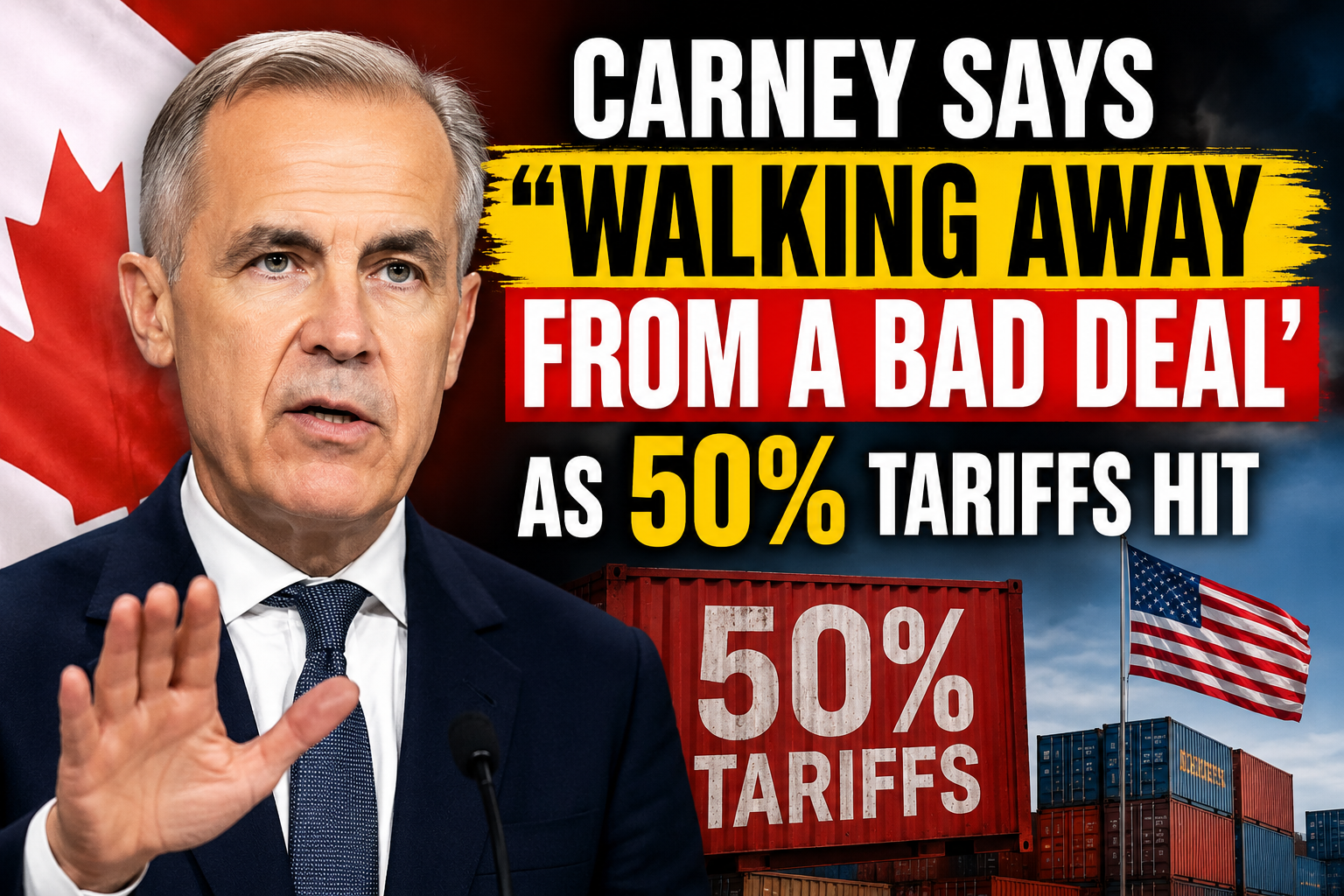
Prime Minister **Mark Carney announced Saturday, August 22, 2026, that Canada is refusing to accept what he described as a “bad deal” from Washington after negotiations between the two countries collapsed.
At the same time, new 50% U.S. tariffs on roughly C$28 billion worth of Canadian goods have now taken effect, setting the stage for Canadian retaliatory tariffs and raising new questions about the future of Canada-U.S. trade.
For Canadians, the dispute is no longer simply another round of political negotiating.
It could affect jobs, businesses, prices and the economic relationship Canada has relied on for generations.
Why Did Canada Walk Away From the U.S. Trade Deal?
Carney said Canada had spent more than a year attempting to negotiate a comprehensive agreement with the United States.
But according to the prime minister, conditions presented by the U.S. near the end of negotiations changed enough that Canada could no longer accept the agreement.
Carney said the new terms were “uneconomic” and “unfair” and raised questions about whether a deal with Washington could be relied upon over the long term.
The prime minister framed Canada’s decision as bigger than tariffs alone.
Canada wanted to maintain its ability to make independent economic decisions, protect domestic industries and negotiate new trade agreements with countries outside the United States.
According to Reuters, Carney said some of the latest American demands would have restricted Canada’s ability to pursue new international trade agreements. Other disagreements involved automobiles and medium- and heavy-duty trucks.
Carney summarized Ottawa’s position clearly: Canada was not prepared to accept the deal that was being offered.
The United States Tells a Different Story
Washington disputes Canada’s version of how negotiations collapsed.
U.S. Trade Representative Jamieson Greer said Canada declined to finalize an agreement under terms that the United States believed had previously been settled.
A senior Trump administration official also argued that the proposed agreement would have provided Canada with some of the most favourable tariff treatment available to a major exporter into the United States.
That disagreement matters.
Canada says the United States introduced unacceptable last-minute changes. Washington argues Canada backed away from an agreement that could have significantly improved its trade position.
For now, neither side appears ready to move quickly back to the negotiating table.
Reuters reported Saturday that Greer said no new trade talks were currently planned.
What Are the New 50% U.S. Tariffs on Canada?
The new U.S. tariffs went into effect shortly after midnight on August 22, 2026.
They impose a 50% duty on approximately US$20 billion — roughly C$28 billion — of Canadian exports entering the United States.
That represents slightly more than 5% of Canada’s total exports to the U.S., according to Reuters.
The tariffs affect products and industries including wine, furniture, dairy products, cement, clothing, fishing rods and hockey equipment.
Importantly, these goods do not receive the preferential tariff treatment that has protected much Canadian trade under the United States-Mexico-Canada Agreement, or USMCA/CUSMA.
That makes the measures particularly painful for businesses operating in industries where margins are already tight.
A 50% tariff can make some Canadian products dramatically more expensive for American buyers almost overnight.
Canada Is Fighting Back With Retaliatory Tariffs
Ottawa does not intend to absorb the new U.S. tariffs without responding.
Carney announced that Canada will match the new American tariffs “dollar for dollar.”
Canada’s retaliatory tariffs are scheduled to begin on September 8, 2026 and will target a range of American products.
The measures are expected to include U.S. steel, dairy products, appliances, agricultural equipment, pulp and paper products, electronics and other goods. The federal government is expected to release more detailed lists before the tariffs take effect.
This means the dispute could increasingly affect businesses and consumers on both sides of the border.
Tariffs are technically taxes paid by importers, but those costs frequently move through supply chains and can ultimately appear as higher prices, reduced profit margins or changes in where companies purchase their products.
Is Canada Now in a Trade War With the United States?
Carney did little to soften his description of the situation Saturday.
When asked whether Canada was now engaged in a trade war, he characterized the new U.S. tariffs as an attack and said Canada had been attacked.
Those are unusually strong words between two countries that have historically maintained one of the world’s closest trading relationships.
Canada and the United States share deeply integrated supply chains in automobiles, steel, agriculture, energy, manufacturing and numerous other industries.
Parts can cross the border multiple times before a finished product reaches consumers.
That means escalating tariffs can create ripple effects far beyond the companies directly importing or exporting the goods being taxed.
Canadian Workers and Businesses Could Feel the Impact
The immediate economic effect may be concentrated in certain industries rather than spread evenly across the entire Canadian economy.
However, the businesses that are directly exposed could face significant pressure.
Trade experts cited by Reuters warned that vulnerable Canadian sectors could experience job losses or even business closures if tariffs make their products too expensive in the American market.
Companies may be forced to absorb part of the tariff, increase their prices, find new customers outside the United States or adjust production.
For smaller Canadian businesses that depend heavily on American customers, quickly replacing the U.S. market may be particularly difficult.
Carney says Ottawa will introduce additional financial measures to support Canadian workers and businesses affected by the tariffs.
The federal government has already provided nearly C$25 billion in support measures over the previous 18 months, according to Carney’s August 21 statement.
Canada’s Bigger Strategy: Reduce Dependence on the U.S.
Perhaps the most important part of Carney’s message had little to do with the immediate tariffs.
His government increasingly appears to believe Canada’s old economic relationship with the United States may not return.
In his August 22 remarks, Carney argued that the international trade environment has fundamentally changed and that Canada needs to become stronger domestically while expanding its relationships with other countries.
That could mean accelerating trade agreements, infrastructure projects, energy exports and investment relationships outside the United States.
The challenge is scale.
Despite Canada’s efforts to diversify, the United States remains overwhelmingly Canada’s most important export market. Reuters estimates that close to 70% of Canadian exports still go to the U.S.
Replacing even a portion of that demand cannot happen overnight.
But Canada’s strategy increasingly appears to be about reducing that dependency over years rather than months.
What Happens Next?
The next major date is September 8, when Canada’s new retaliatory tariffs are scheduled to begin.
Before then, Ottawa is expected to reveal additional details about exactly which U.S. products will be targeted and what assistance will be provided to Canadian industries affected by the American tariffs.
Whether negotiations restart is less clear.
The two governments were seemingly close to an agreement only hours before discussions collapsed, suggesting a compromise may still be possible eventually.
But the rhetoric has hardened considerably.
The dispute also arrives as questions continue to surround the longer-term future of the USMCA/CUSMA trade framework between Canada, the United States and Mexico.
If relations continue deteriorating, the consequences could extend well beyond this particular round of tariffs.
What This Means for Canadians
For most Canadians, the 50% tariff will not suddenly mean everything imported from or exported to the United States becomes 50% more expensive.
The new tariff applies to a specific group of Canadian exports worth roughly C$28 billion rather than Canada’s entire trade relationship with the United States.
The bigger concern is escalation.
If both governments continually add tariffs in response to one another, the number of industries affected could increase.
Canadian manufacturers could face weaker demand from American customers. Businesses that depend on U.S. components could pay more. Consumers could eventually see price increases on some American goods targeted by Canada’s retaliatory measures.
And businesses on both sides of the border could delay investment because they do not know what trade rules will look like several months from now.
Economic uncertainty can sometimes be nearly as damaging as tariffs themselves.
Carney Is Making a High-Stakes Bet
Walking away from negotiations is a significant gamble for Mark Carney.
Accepting a deal could have reduced uncertainty and provided relief to major Canadian industries.
But Carney’s government concluded that the proposed agreement required concessions Canada should not make.
Politically, that puts the prime minister’s negotiating philosophy to the test.
Carney is essentially arguing that accepting a poor agreement for short-term stability would be worse than enduring immediate economic pressure while Canada builds greater independence.
Ontario Premier Doug Ford publicly supported the decision Saturday, saying the proposed agreement would have been damaging for Ontario’s auto, steel and manufacturing industries. Federal Conservative Leader Pierre Poilievre also called for Canadians to remain united against what he described as unfair attacks on Canadian jobs and businesses.
That level of political support may help Ottawa in the short term.
The harder question is what happens if the trade confrontation lasts months — or years.
The Bottom Line
The Canada-U.S. trade dispute has entered a much more serious phase.
As of August 22, 2026, new 50% U.S. tariffs are hitting roughly C$28 billion worth of Canadian exports after negotiations between Ottawa and Washington collapsed.
Carney says Canada chose to walk away because the proposed agreement was not in the country’s economic or national interest.
Washington says Canada rejected what would have been a favourable agreement.
Canada will now retaliate with its own tariffs beginning September 8 while preparing additional support for affected workers and businesses.
What happens next could determine far more than the price of Canadian wine, hockey equipment or American electronics.
It could help define the future of Canada-U.S. trade itself.
For decades, Canadians could largely assume that economic integration with the United States would continue to deepen.
In 2026, that assumption can no longer be taken for granted.

Leave a Reply