The collapse of Canada-U.S. trade negotiations has produced increasingly blunt language from Canadian political leaders — and British Columbia Premier David Eby is among the most outspoken.
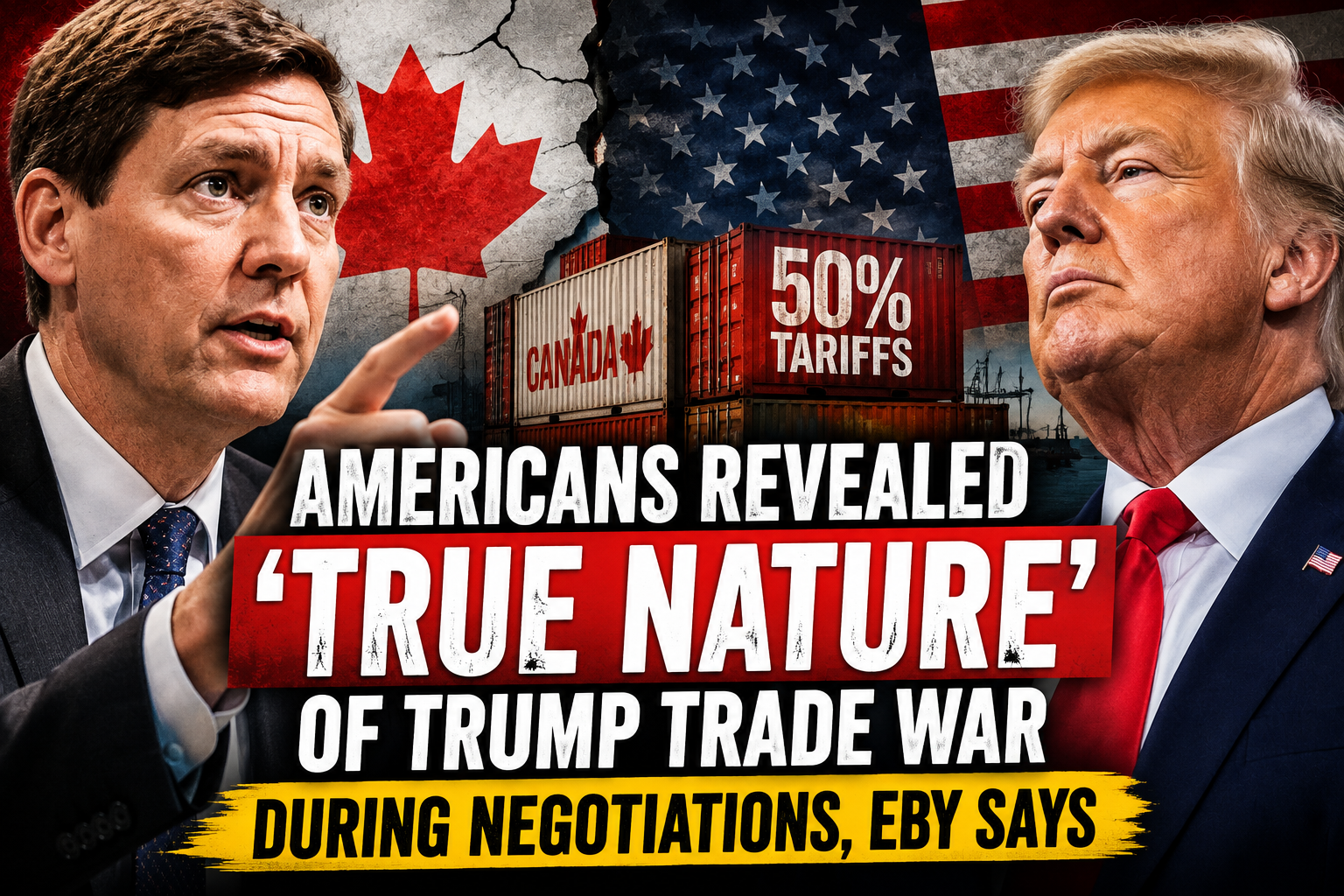
After negotiations broke down and the United States imposed new 50% tariffs on approximately $20 billion worth of Canadian products, Eby said the demands Washington made during the negotiations revealed the “true nature” of what the White House wanted from Canada.
For Eby, the dispute is no longer simply about steel, lumber, automobiles or tariffs.
It is about Canada’s ability to make its own economic decisions.
And according to the B.C. premier, some of the U.S. demands went far beyond traditional trade negotiations.
Eby Says U.S. Demands Exposed the ‘True Nature’ of the Dispute
Speaking Saturday, August 22, Eby argued that the negotiations showed Canadians what the Trump administration ultimately expected from its northern neighbour.
One issue stood out in particular: Canada’s ability to trade freely with countries outside the United States.
Eby said a proposal that Canada restrict its trade relationships with other countries could leave the country as the “economic equivalent of the 51st state.”
That is an extraordinary accusation.
But it reflects the increasingly serious disagreement between Ottawa and Washington over what a new economic relationship between the two countries should actually look like.
Canada went into negotiations seeking tariff relief and greater stability.
According to Prime Minister Mark Carney, Ottawa was prepared to make significant concessions. Canada was willing to remove remaining retaliatory tariffs in strategic sectors if Washington substantially reduced its tariffs on Canadian steel, aluminum and automobiles.
Ottawa was also prepared to encourage provinces to restore American alcohol to Canadian shelves and discuss administrative measures involving Canada’s supply-management system.
But Carney said there were lines Canada would not cross.
Those included Canadian sovereignty, cultural protections, the French language and Canada’s ability to pursue an independent trade policy.
Carney: ‘They Asked Too Much and Offered Too Little’
The dispute exploded after the two sides appeared remarkably close to reaching an agreement.
Earlier in the week, both Canadian and American officials had expressed optimism.
Instead, negotiations collapsed Friday night.
Carney said the United States introduced new terms in the final stages that Canada considered economically unacceptable.
“They asked too much and offered too little,” Carney said Saturday.
Canada subsequently suspended negotiations and recalled its negotiating team to Ottawa.
Washington tells the story differently.
U.S. Trade Representative Jamieson Greer said the Trump administration had offered Canada significant tariff reductions, including relief involving autos, steel and lumber, and argued that Canada chose not to accept the agreement.
That difference in interpretation now sits at the centre of the dispute.
Washington says Canada walked away from favourable terms.
Ottawa says those terms came with conditions that would have compromised Canada’s economic independence.
Why Eby Is Talking About the ‘51st State’
Eby’s language cannot be separated from President Donald Trump’s repeated comments about Canada potentially becoming America’s 51st state.
Trump’s remarks have dramatically changed the political context surrounding trade negotiations.
A disagreement over tariffs is one thing.
A disagreement over tariffs while the U.S. president repeatedly discusses Canada’s place inside the United States is something entirely different.
Eby has been making this argument for some time.
In 2025, the B.C. premier accused Trump of attempting to hurt Canada economically to increase political pressure on the country, declaring that British Columbia would never accept becoming part of the United States.
The latest negotiations appear to have strengthened his view.
If Washington’s demands included restricting Canada’s ability to negotiate trade agreements elsewhere, Canadian leaders can reasonably view the issue as extending beyond the normal debate over tariffs.
For Eby, that is apparently the point.
The “true nature” he says was exposed during the negotiations was not simply that Washington wants better trade terms.
It was that Washington wants significantly more influence over Canada’s economic choices.
The New 50% Trump Tariffs Are Now in Effect
The political fight is already producing economic consequences.
The United States imposed 50% tariffs on about $20 billion worth of Canadian goods early Saturday after the two countries failed to reach an agreement.
The products affected represent roughly 5% of Canada’s annual exports to the United States, according to the Associated Press.
The impact will not be distributed evenly across Canada.
That is particularly important for British Columbia.
The province’s lumber and resource industries have already dealt with longstanding U.S. trade disputes, and Eby warned British Columbia could be disproportionately affected by the latest escalation.
For communities dependent on forestry and exports, another round of American tariffs is not an abstract political argument.
It can determine whether mills remain operating, whether companies continue investing and whether workers keep their jobs.
Eby Isn’t Ready to Put American Alcohol Back on B.C. Shelves
One of the most visible Canadian responses to Trump’s trade policies has been the removal of American alcohol from provincial liquor stores.
That policy has taken on symbolic importance.
During negotiations, Ottawa indicated it could encourage provinces to return American alcohol to shelves as part of a broader agreement.
But with negotiations now collapsed, Eby says British Columbia isn’t prepared to do that without meaningful movement from Washington.
He specifically linked the issue to U.S. duties on Canadian softwood lumber.
That creates another pressure point.
For American wineries and spirits producers hoping to regain access to Canadian provincial liquor systems, the breakdown in negotiations could mean continued lost sales.
And Eby suggested British Columbia may not be finished responding.
He said the province was willing to consider every available tool in what he described as an “economic war.”
Canada Is Preparing Dollar-for-Dollar Retaliation
British Columbia’s response will also operate alongside measures from Ottawa.
Carney announced that Canada plans to impose targeted retaliatory tariffs beginning September 8, 2026.
The federal government says the response will match the value of the new American tariffs “dollar for dollar.”
Potentially affected sectors include steel, dairy, appliances, agricultural equipment, pulp and paper and electronics.
The result could be another dangerous escalation.
American tariffs increase costs for Canadian exporters.
Canadian tariffs then increase costs for American exporters.
Businesses pressure their governments.
Governments respond with additional measures.
Before long, a disagreement intended to produce concessions can develop into a prolonged trade war that damages companies and consumers on both sides of the border.
The Biggest Casualty May Be Trust
The economic impact matters.
But something even harder to rebuild may already have been damaged: trust.
Canada and the United States conducted roughly $880 billion worth of trade in goods and services last year, while nearly 72% of Canadian goods exports went to the American market.
The two economies were built around the assumption that their unusually close relationship would remain relatively stable.
Factories were constructed around cross-border supply chains.
Businesses made investments assuming predictable market access.
Governments negotiated NAFTA and later CUSMA with the expectation that clearly defined trade rules would provide certainty.
Carney now says Canada has learned something different.
“America has changed,” the prime minister said following the collapse of negotiations, adding that Canada should not expect to return to the previous relationship.
That may ultimately prove more consequential than any individual tariff.
British Columbia Was Already Preparing to Depend Less on America
Eby’s government has increasingly pursued trade diversification.
In June 2026, Eby led a trade mission to China as part of British Columbia’s Look West strategy, designed in part to develop markets outside the United States.
The province has highlighted opportunities in forestry, energy, agriculture, critical minerals and tourism.
Earlier trade missions and agreements have similarly focused on reducing B.C.’s vulnerability to economic decisions made in Washington.
That strategy now looks increasingly important.
The United States will remain an enormously important market for Canadian products because geography, infrastructure and decades of economic integration cannot simply be replaced.
But Canada’s political leaders are increasingly asking whether being too dependent on the American market gives Washington too much leverage.
Eby’s answer appears clear.
This Trade War Is Becoming About Sovereignty
There is another important distinction.
The actions of the Trump administration should not be confused with the views of all Americans.
American companies, workers and consumers can also be hurt by tariffs, particularly when heavily integrated supply chains mean U.S. manufacturers rely on Canadian materials and components.
Major U.S. business organizations have already warned that tariffs and Canadian retaliation could increase costs for American businesses and families.
That makes Eby’s criticism specifically about the White House’s trade strategy rather than Americans as a whole.
But politically, Canadian leaders are clearly becoming more comfortable describing the conflict in terms normally reserved for much larger disputes.
“Economic war.”
“Attack.”
“51st state.”
“Sovereignty.”
Those are not the words traditionally associated with Canada-U.S. trade negotiations.
Their use demonstrates how dramatically the relationship has deteriorated.
What Happens Next?
For now, there is no obvious path back to an agreement.
The United States has imposed its tariffs.
Canada is preparing retaliation for September 8.
And no immediate additional negotiating meetings were scheduled following Friday’s collapse.
Economic pressure could eventually force both governments back to the table.
Canadian companies want access to the U.S. market.
American companies have reasons to avoid higher input costs and Canadian retaliation.
Both economies benefit from cross-border trade.
But any future negotiations will now begin with considerably less trust.
And Canada may approach them differently after seeing what Washington demanded this time.
The Bottom Line
David Eby’s comments capture how the Canadian political conversation surrounding Donald Trump’s trade war has changed.
What began as a dispute over tariffs has increasingly become a debate about how economically independent Canada can remain while maintaining its extraordinarily close relationship with the United States.
Eby believes the latest negotiations provided an answer about Washington’s intentions.
When U.S. demands potentially extended to Canada’s relationships with other trading partners, he argued they revealed the “true nature” of the dispute — one that could leave Canada functioning as the economic equivalent of America’s 51st state.
Washington strongly disputes Canada’s interpretation of the negotiations and maintains it offered Ottawa favourable terms.
But the immediate result is undeniable.
The deal is gone.
The 50% tariffs are here.
Canada is preparing retaliation.
And whatever happens next, the Canada-U.S. relationship coming out of this trade war may look very different from the one that entered it.
Suggested URL Slug
david-eby-trump-trade-war-true-nature-canada-us
Suggested SEO Keywords
David Eby, Donald Trump, Trump trade war, Trump tariffs Canada, Canada U.S. trade war, Canada 51st state, Mark Carney, U.S. tariffs Canada, Canada tariffs 2026, British Columbia tariffs, Canada U.S. negotiations, CUSMA, softwood lumber tariffs
Suggested Tags
David Eby, Donald Trump, Mark Carney, Canada, United States, Tariffs, Trade War, British Columbia, Canadian Economy, U.S. Economy, CUSMA, Politics, Breaking News

Leave a Reply