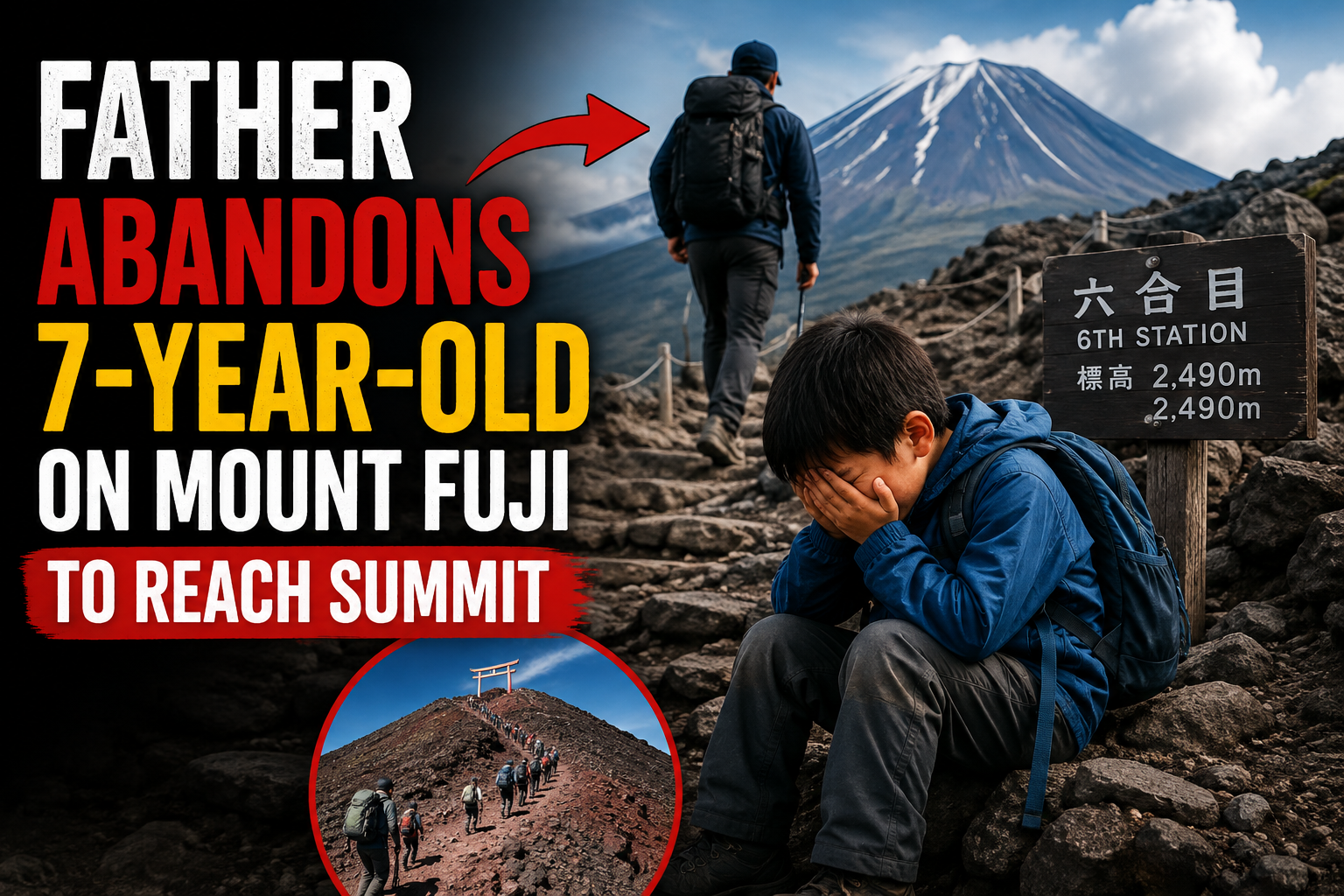
A family climb up Mount Fuji turned into a police intervention after a father reportedly left his exhausted 7-year-old son alone on the mountain so he could continue climbing toward the summit.
The incident occurred on August 20, 2026, along the Fujinomiya Trail on Japan’s famous Mount Fuji. The young boy was eventually discovered alone near the sixth station at roughly 2,500 metres above sea level, prompting mountain-hut staff to contact police.
Fortunately, the child was found unharmed.
But the circumstances surrounding why he was left behind have generated widespread criticism and renewed questions about the responsibility adults have when taking young children into high-altitude environments.
What Happened on Mount Fuji?
According to Japanese media reports, the 7-year-old boy had travelled from Nagoya with his 48-year-old father and older brother to climb Mount Fuji.
The three were taking the Fujinomiya Trail, which begins at a high elevation and provides one of the shortest routes to the summit.
Shortly after beginning the climb, however, the youngest member of the group reportedly became exhausted and complained that he was tired.
Instead of turning around with him, the father allegedly told the boy to remain near the sixth station.
According to the child and mountain-hut staff, he had been told to wait there for approximately eight hours.
The father and older brother then continued farther up Mount Fuji.
Mountain-Hut Worker Finds 7-Year-Old Alone
At around 7 a.m., a worker at a mountain hut noticed the boy sitting alone on a bench.
Staff reportedly became concerned after it became clear that the child’s father was not returning.
The boy was carrying some climbing equipment, but according to one mountain-hut employee, his food consisted primarily of snacks and a soft drink, and he reportedly had no money with him.
Mountain-hut workers brought the child inside and contacted authorities.
Police received a report at approximately 7:40 a.m. that a child had apparently been left alone near the sixth station. Officers later reached and protected the boy.
He was tired but was not reported to have suffered any injuries.
Father Had Continued Up the Mountain
Police then attempted to locate the boy’s father.
By the time authorities made contact with him, he had reportedly climbed as far as the eighth station.
Police instructed him to turn around.
The father eventually returned to the sixth station, where the family was reunited. Japanese reports say police gave him a strong verbal warning over his decision to leave the child behind.
TV Asahi reported that police warned the father that his actions could potentially violate criminal laws and stressed that a mountain hut is not a childcare facility. The father reportedly acknowledged that he had made a rash decision.
Why Leaving a Child Alone on Mount Fuji Is So Dangerous
Mount Fuji may be one of the world’s most recognizable mountains, but its popularity can create the misleading impression that climbing it is easy.
It isn’t.
At 3,776 metres, Mount Fuji is Japan’s highest mountain. Its official climbing website specifically warns visitors that it is a serious high-altitude environment requiring preparation and the willingness to descend if someone becomes unwell.
Conditions can also change quickly.
Even during summer, temperatures near the summit can approach 0°C before sunrise, while wind, rain, fog and thunderstorms can rapidly make conditions more dangerous.
For a 7-year-old separated from his family, those risks become significantly greater.
Children Face Additional Risks at High Altitude
The official Mount Fuji climbing guidance specifically warns parents to closely monitor children.
Children can face a greater risk of altitude sickness than adults because of their developing cardiopulmonary systems, and officials recommend that parents pay close attention to a child’s condition and never push them too hard.
Symptoms of altitude sickness can include fatigue, headaches, dizziness, nausea and weakness.
That makes a child’s statement that he or she is tired particularly important during a high-altitude hike.
Turning around may be disappointing.
Ignoring those warning signs can be dangerous.
The Most Important Rule in Group Hiking
After the Mount Fuji incident, police offered a straightforward reminder for anyone climbing in a group: adjust the group’s pace to the person with the lowest level of physical stamina and avoid becoming separated.
That principle becomes even more important when children are involved.
Reaching a summit is optional.
Keeping every member of the group safe is not.
If a child becomes exhausted, frightened, sick or unwilling to continue, the appropriate response is to stop, rest or descend together—not to leave the child behind so others can complete the climb.
Incident Sparks Outrage in Japan
The story quickly attracted attention after it was reported in Japanese media, with many online commenters questioning how a parent could leave a 7-year-old alone at such a high elevation.
The reaction reflects something larger than one controversial parenting decision.
Mountaineering depends heavily on judgment.
Weather changes. People get tired. Plans fail. Sometimes reaching the summit simply isn’t possible.
Knowing when to abandon the goal is part of responsible climbing.
Mount Fuji’s official safety guidance makes essentially the same point, warning climbers that they need the courage to descend when they are not feeling well rather than forcing themselves upward.
The Boy Was Found Safe
Thankfully, this incident ended without a serious injury.
The 7-year-old was protected by mountain-hut staff and police and eventually reunited with his father and brother.
But the outcome could have been very different.
A rapidly changing mountain environment combined with cold temperatures, exhaustion, altitude and a young child being alone can quickly create an emergency.
The story serves as a reminder that Mount Fuji may attract hundreds of thousands of visitors and appear accessible, but it remains a mountain where preparation, judgment and responsible supervision matter.
For families especially, reaching the summit should never take priority over the safety of a child.
SEO Information
SEO Title: Father Abandons 7-Year-Old on Mount Fuji to Continue Summit Climb
Meta Description: A father reportedly left his exhausted 7-year-old son alone on Mount Fuji and continued climbing toward the summit. Police later intervened and reunited the family.
Suggested URL Slug: father-abandons-7-year-old-mount-fuji
Primary Keyword: Father abandons 7-year-old on Mount Fuji
Secondary Keywords: Mount Fuji child abandoned, Mount Fuji father son, 7-year-old Mount Fuji, Mount Fuji climbing incident, Japan Mount Fuji news, child left alone Mount Fuji, Fujinomiya Trail incident, Mount Fuji hiking safety
FAQ
Why was the 7-year-old left alone on Mount Fuji?
Reports say the boy became tired during the climb. His father allegedly told him to wait near the sixth station for around eight hours while the father and the boy’s older brother continued farther up the mountain.
Where was the child found?
He was found near the sixth station of Mount Fuji’s Fujinomiya Trail, at an elevation of roughly 2,500 metres.
Did the father reach the summit of Mount Fuji?
Current reporting confirms that the father had reached approximately the eighth station when authorities contacted him and instructed him to return. Although some reports describe him as heading for the summit, it is not clear that he actually reached the summit.
Was the child injured?
No. Police reported that the 7-year-old was unharmed when he was protected and later reunited with his family.
Is Mount Fuji safe for children?
Children can climb portions of Mount Fuji with proper preparation and supervision, but the official Mount Fuji climbing website warns that children may face a greater risk of altitude sickness and should never be pushed too hard.

Leave a Reply