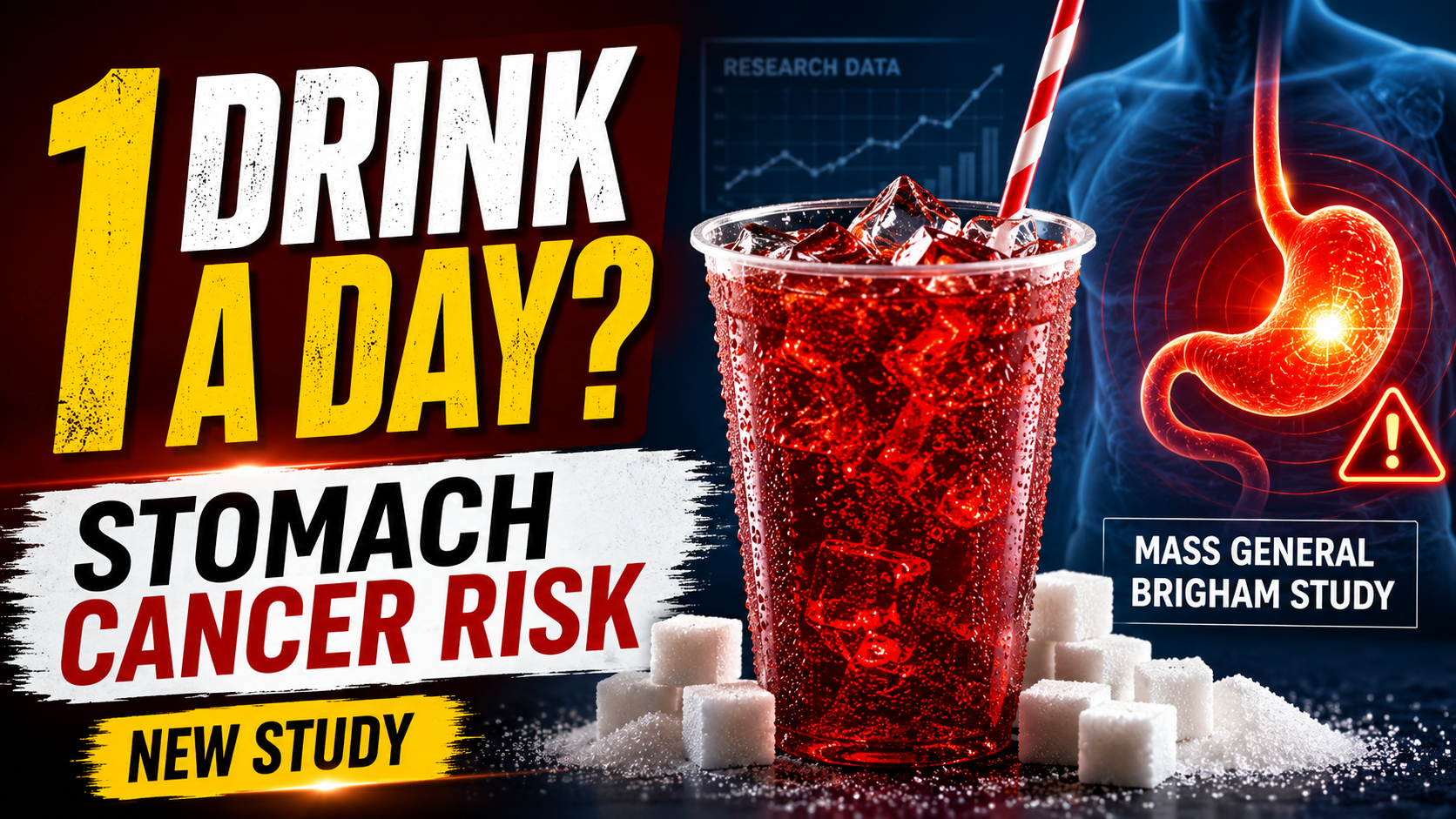
For millions of people, grabbing a soda, lemonade, fruit punch, or sports drink is simply part of the daily routine.
But a major new study from researchers at Mass General Brigham Cancer Institute is raising questions about what that habit could mean over the long term.
Researchers found that people who consumed at least one sugar-sweetened beverage per day had a 2.45-fold higher risk of developing gastric — or stomach — cancer compared with people who drank these beverages less than once a month.
The findings, published in Gastro Hep Advances, are drawing attention because researchers say this is the first study to demonstrate an association between sugar-sweetened beverage consumption and gastric cancer in a U.S. population.
But there is an important distinction: the study found an association, not proof that sugary drinks directly cause stomach cancer.
Here is what researchers discovered, which drinks were included, and what the findings actually mean.
What Did the Mass General Brigham Sugar Drinks Study Find?
Researchers analyzed health and dietary information from 112,284 adults who participated in two long-running U.S. research projects: the Nurses’ Health Study and the Health Professionals Follow-Up Study.
Those studies have collected detailed information about participants’ diets, lifestyles and health for decades.
During the follow-up period, 278 participants developed gastric cancer.
After adjusting for a number of other potential risk factors, researchers found a striking difference.
People consuming one or more sugar-sweetened drinks every day had approximately 2.45 times the risk of stomach cancer compared with people consuming fewer than one sugary beverage per month.
The association appeared in both men and women.
Among women in the Nurses’ Health Study, the numbers were even more noticeable. Women who drank more than one sugar-sweetened beverage per day had a 3.04-fold higher risk compared with women who rarely consumed them.
That does not mean someone who drinks a soda every day is guaranteed to develop cancer. Gastric cancer remains relatively uncommon in the United States, and relative risk is different from a person’s absolute individual risk.
Still, the findings give researchers another reason to investigate the potential long-term effects of high sugar consumption.
What Counts as a Sugar-Sweetened Beverage?
You might immediately think of regular soda, but researchers included several popular drinks.
Sugar-sweetened beverages in the study included:
- Regular carbonated soft drinks
- Fruit punch
- Lemonade
- Sports drinks
These beverages commonly contain substantial amounts of added sugar, including fructose-containing sweeteners.
That last point may be particularly important.
Researchers found that higher total fructose intake was also associated with a greater incidence of gastric cancer.
Why Could Sugary Drinks Be Connected to Stomach Cancer?
Scientists do not yet know exactly what could explain the association.
One potential clue is fructose.
Fructose is commonly found in sweeteners used in sodas, fruit punches and other sweetened beverages. The study found that as fructose consumption increased, stomach cancer incidence also tended to increase.
Researchers will need additional studies to determine whether fructose itself affects cancer development or whether sugary beverage consumption is connected with other biological or lifestyle factors that influence risk.
Mass General Brigham gastroenterologist and senior study author Dr. Andrew T. Chan has also pointed to broader concerns surrounding rising rates of gastrointestinal cancers and dietary patterns that include sugary beverages and ultra-processed foods.
However, those theories still need significantly more research before scientists can establish a direct cause-and-effect relationship.
What About H. Pylori?
One of the biggest known risk factors for stomach cancer is infection with Helicobacter pylori, commonly known as H. pylori.
The bacteria can live in the stomach lining and cause chronic inflammation. Long-term infection can increase the risk of ulcers and gastric cancer.
Because H. pylori is so important to stomach cancer risk, researchers examined infection status in a subset of 940 study participants.
Just over one-third showed evidence of H. pylori infection.
Interestingly, researchers did not find an association between sugary drink consumption and H. pylori infectionwithin that subset.
That suggests the relationship seen between sugary beverages and cancer cannot simply be explained by sugary drink consumers being more likely to have H. pylori.
Still, because H. pylori information was only available for a relatively small number of participants, researchers cannot completely rule out its influence.
What About Diet Soda and Artificial Sweeteners?
Another intriguing part of the study involved artificially sweetened beverages.
Researchers examined low-calorie carbonated drinks separately from regular sugar-sweetened beverages.
After researchers adjusted for other health and lifestyle factors, higher consumption of artificially sweetened drinks was not associated with an increased incidence of gastric cancer.
That does not necessarily mean diet soda prevents stomach cancer or should be considered a health food.
It simply means this particular study did not detect the same gastric cancer association with artificially sweetened drinks that researchers observed with sugar-sweetened beverages.
Does Drinking Soda Cause Stomach Cancer?
This is the most important question — and the answer right now is no one can say that based on this study alone.
The research was observational.
That means researchers followed people’s behaviors and health outcomes rather than randomly assigning participants to drink sugary beverages for years.
Observational research can identify potentially important associations, but it cannot definitively prove that one factor caused another.
As Chan explained, the research demonstrates an association, but additional studies will be required to establish whether the connection is actually causal.
There are also several limitations.
Participants were predominantly White healthcare professionals, meaning the results may not necessarily apply equally to every racial or ethnic population.
Researchers also had limited data regarding participants’ family histories of stomach cancer and H. pylori infection.
At the same time, the study has notable strengths.
It included more than 112,000 participants and benefited from decades of detailed information about diet, health and lifestyle. That allowed researchers to account for many potential competing risk factors.
Why This Study Is Getting So Much Attention
Sugary beverages have already been studied extensively because of their connections with conditions such as obesity, type 2 diabetes and cardiovascular disease.
Cancer research is becoming another area of interest.
Previous studies have investigated potential associations between sugar-sweetened beverages and colorectal, breast and liver cancers. Until now, however, evidence specifically connecting sugary drinks with gastric cancer was limited.
That makes the new Mass General Brigham research particularly noteworthy.
Researchers are essentially asking whether something consumed routinely by millions of people could be one modifiable factor associated with a serious form of cancer.
Approximately 65% of U.S. adults report consuming one or more sugar-sweetened beverages each day, according to the Mass General Brigham report.
Even a relatively small health effect could therefore become significant when applied across such a large population.
Should You Stop Drinking Sugary Drinks?
This study alone is not a reason to panic after drinking a can of soda.
The results concern long-term consumption patterns, not an occasional sugary beverage.
But reducing added sugar is already consistent with widely accepted nutrition advice, regardless of whether future research ultimately proves a causal relationship with gastric cancer.
For people who regularly drink multiple sugary beverages each day, simple alternatives can include water, sparkling water, unsweetened coffee or tea, or gradually reducing the amount and frequency of sweetened drinks.
The biggest takeaway isn’t that one soda will cause cancer.
It’s that a daily habit that seems relatively harmless may deserve more attention than many people realize.
The Bottom Line
The new Mass General Brigham sugar drinks study adds another potentially significant piece to the growing research surrounding sugary beverages and long-term health.
Among more than 112,000 adults, consuming at least one sugar-sweetened beverage per day was associated with a 2.45-fold higher risk of gastric cancer compared with consuming fewer than one per month. Researchers also found an association between higher fructose consumption and stomach cancer incidence, while artificially sweetened beverages did not show the same association.
But the study does not prove that sugary drinks cause stomach cancer.
Further research involving more diverse populations and better information about factors such as H. pylori infection will be necessary.
For now, the findings offer one more reason to pay attention to just how much added sugar we’re drinking — especially when that occasional soda quietly becomes an everyday habit.
Frequently Asked Questions
Do sugary drinks cause stomach cancer?
The study did not prove causation. It found an association between frequent sugar-sweetened beverage consumption and a higher incidence of gastric cancer.
How much sugary drink consumption was associated with higher risk?
People drinking at least one sugar-sweetened beverage per day had a 2.45-fold higher gastric cancer risk than people drinking fewer than one per month.
Which sugary drinks were included?
Researchers included regular carbonated drinks, fruit punch, lemonade and sports drinks.
Did diet soda increase stomach cancer risk?
Researchers did not find an increased gastric cancer incidence associated with higher consumption of artificially sweetened beverages after adjusting for other factors.
Where was the study published?
The research, titled “Association between sugar-sweetened and artificially sweetened beverage intake and gastric cancer incidence,” was published in Gastro Hep Advances in 2026.
Suggested Tags: Mass General Brigham, sugary drinks, stomach cancer, gastric cancer, soda, sugar, fructose, cancer research, health news, nutrition

Leave a Reply